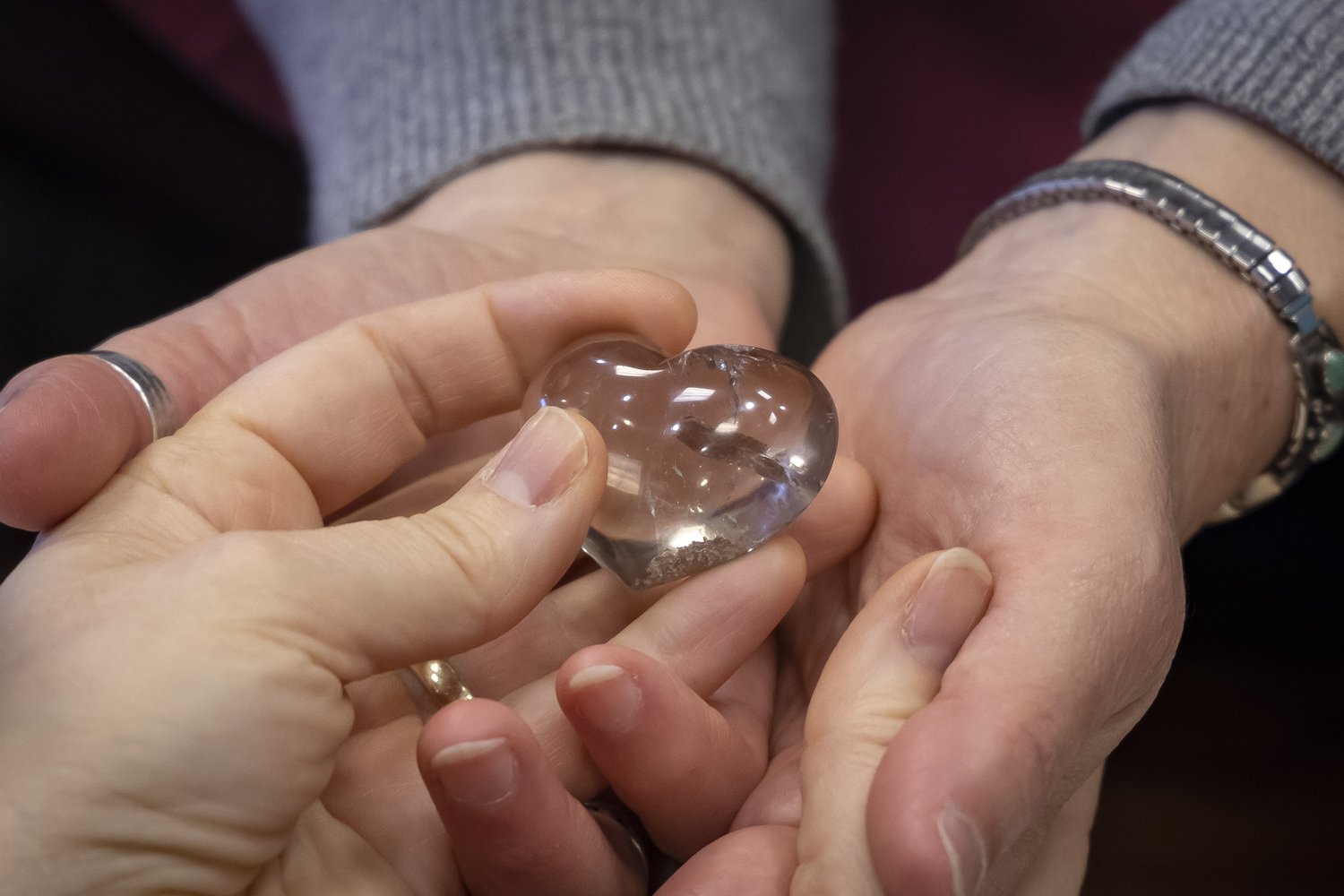
“R’eih;” Seeing Blessings within Curses
Who’s to say and how do we know what’s a blessing and what’s a curse...if we can allow ourselves to ask the question, so taboo? Especially when people are suffering: “How dare you say that what I’m going through might be a blessing?”
Like the story of a man who has mishap after mishap in his life. In a long line of curses and condolences, his son finally breaks his leg. Yet a war breaks out shortly, and the only young man who isn’t hauled off is the one with the broken leg. A curse is turned into a blessing.
Does it come down to the way we look at things? The way we “see”?
The title of this week’s Torah reading, and the very first word, is R’eih: See: A commandment.
Last week, I said that the world requires us to live with our eyes wide open. The reality is a painful sight: Coronavirus, illness, death, unemployment, homelessness, deportation, our president, earthquakes, hurricanes, no electricity, explosions...
How could any of this ever be a blessing? Isn’t it much more realistic--aren’t we seeing more clearly--when we talk about how horrible everything is? My depressive father used to say with a little chuckle, teasing himself a bit, “Those who are depressed see the world as it really is. Those who aren’t, are delusional.” There’s even a psychological term for it: Depressive Realism.
What a depressing time we’re in. It seems that finally, more and more people are seeing the world as it really is. Should we say “yay” to that? It feels scary and cruel to state; The pandemic has been a curse, for sure, yet so many blessings have come out of it.
It was a curse to get sick and live in fear of losing my husband, and to continue to suffer the after-effects of Corona, yet a blessing to be able to see a clear path in a different direction, directly caused by the suffering. This new vision has allowed for an opening of space for new things to happen, creating something new for myself and separating from toxic relationships.
It’s a curse not to be able to gather and sing together in our communities, yet it’s been a blessing to be able to explore other communities far away--because of the internet--that thing we’ve said was also a curse.
Not being able to see family and friends feels like a curse, yet it has made certain bonds stronger and deeper on a new level, especially with my children.
Our curse of a president has brought the blessing of forcing so many people out of complacency--seeing more clearly what needs to be done in the world and acting on it.
The other day, after hurricane Isaias hit, I went walking in Central Park. As I passed one of my favorite spots, what I like to call “my meadow,” I saw that one of my favorite trees had been ripped out of the ground from its roots. It’s a spot I discovered in the spring when I was beginning to recover from COVID, with a beautiful ground covering underneath, a spot I chose to practice yoga and Qi Gong--a healing place for me. Surrounded on one side by very tall trees, it seemed highly unlikely to be a target of the hurricane winds, so low. Yet there it lay languishing on its side, its wide bushy branches spread out and leaning on the ground. I went over to it and touched its branches and cried.
In this week’s Torah reading, the bible tells us to destroy all the sites where other gods have been worshiped, whether on mountaintops or under luxurious trees. What a strange thing to imagine; altars under luxurious trees? Mountaintops? Sure. But under luxurious trees? Why luxurious?
It seems clear that we are to leave the tree alone and just destroy the false gods and altar, but it still felt sad as I thought of the destruction of this favorite little tree in a spot that felt incredibly luxurious in this big, hot city full of concrete where I’m stuck because of the pandemic.
The injunction is a continuation of last week’s parsha; walk in the way of God, a One God of Unification, not many gods separate from each other and us; wake up to the fact that all of life is connected; live with humility, not arrogance; know the source of the abundance in your life, for it is not your own hands that created it; know that this earth is a gift and treat it as such.
Is it unrealistic to see the blessings in the curses? Is it unrealistic to think that we can change the world--even after all this? Perhaps. But I’d rather be delusional and live with hope and belief that we can change the world, as Rabbi Michael Lerner, author of Revolutionary Love, A Political Manifesto to Heal and Transform the World, among other revolutionary works, says. I’d rather believe in the infinite possibility of transformation. That is God to me: the possibility of transformation for the whole world, even with the pain.
Maybe there is a blessing in the fall of that beautiful little tree. Maybe it has made space for something else that I can’t yet see.
“Eikev,” Pilot Lights and Firecrackers: Spiritual Lessons for living in what seem like hopeless times
A year ago at this time, I supported a bas mitzvah student of mine, a certain Rebecca who is not mine but has the same curly hair and name as my own younger daughter, as she stood in front of our congregation and spoke prophetically about the urgency of the climate and Greta Thunberg; if we live in the ways of God, take care of each other and the earth, then we will make it into the Land of Milk and Honey.
Continuing from her message: We can help the earth, and all that lives on earth, find its balance again if we remove the layers we have protecting our hearts.
I suppose we are all afraid to feel too much; if we allow ourselves to start crying, maybe we’ll never stop. Right?
This morning, after a week of excruciating pain in my head, I may have reached a new level of acceptance--not about the climate, no, but about my challenges...
...Acceptance that I will not be “balanced” or find any kind of complete balance during this time...that I will continue to have migraines that will incapacitate me for periods of time...that I will continue to feel stuck, just like everyone else...that I will continue to struggle find balance and to counter this feeling of stuckness with positive messages.
You get the idea. I know you have your own list of “shoulds” that could be turned into a kind of acceptance or surrender.
And so it should be--this continued struggle. If I didn’t continue to struggle, it would mean I was giving up. Instead, I choose hope, as I said last week in my blog post, No Room for Despair; there is no room for despair.
Following is another hopeful message, this time from the late congressman John Lewis’s words in an old interview with Krista Tippet on NPR’s On Being. He talked about pilot lights (as in the little constant flame in the old gas stoves) as opposed to firecrackers.
I paraphrase: “You tell us to wait. You tell us to be patient. We can not wait. We can not be patient. We want our freedom now...But that has to be balanced. Pace yourself. You don’t change the world and society in a few days. It’s better to be a pilot light than a firecracker.”
In other words, be an “Aish Tamid”--a continuous flame that is never allowed to go out.
But what about the environment, you say--I say! We’re running out of time! Haven’t you heard?? The arctic is not just warming, it’s burning up!!
True. Yet, I must choose hope. I have no choice.
Some of you may believe in people who get messages from the spirit world, some may not. No matter. Again, I think of this as a choice, like believing in God. (There’s no proof either way, so why not believe in the thing that makes you happier and live longer and healthier? I quote from Dr. Mario Martinez in his book, The MindBody Code, 2014—I read it a few years ago and consider it an important part of my spiritual journey.)
I have a friend who forwards me monthly messages and predictions from a certain Sara Wiseman. Sara is not the only one carrying messages that humanity is waking up, and that we’re close--really close--to things changing for the better, including the earth healing itself.
The message is that the pain we are experiencing, if we allow ourselves to, physical or emotional, is that of humanity “burning karma,” not just for our own families, not just for recent generations but for the whole world. It says that we are past the worst. After all, how much more “worst” can we take? The spirit world asks that we live with our eyes wide open, allowing ourselves to feel the pain, for with this kind of living, we will achieve the healing the world needs.
In this week’s Torah reading, Eikev, we are asked to cut away, or circumcise, the foreskin of our hearts, the extra layer that we use to protect ourselves from feeling the pain, and live in God’s ways.
I want--I have to believe that humanity as a whole is waking up, that real change (revolution?) is around the corner, and that this pain, this personal pain I experience each time I struggle with migraines, each time there is nothing, I mean nothing, I can take that “works,” is giving birth to something truly new.
There is really nothing we can take that will cover up the pain we are all feeling right now as a collective. I mean nothing.
So let’s be like pilot lights, take care of ourselves, keep seeking balance, for our bodies and our activism, and live with our hearts and eyes wide open.
Let’s strip away any extra layers that make us blind or unfeeling.
Yes, protect ourselves from overload, but also allow ourselves to feel and see. The more we do this, the more we are helping our own selves and the world.
Tisha B’Av: No Room for Despair
I’ve never been much into Tisha B’av. Maybe nobody is. After all, it brings us into a place of mourning over a Temple from two thousand years ago that we can’t really relate to if we’re not from a religious community. And if we’re part of the progressive Jewish community, then we are forced to face the pain of today’s society.
These days, we’re a bit overloaded, no exaggeration.
But I was pleasantly surprised yesterday when my 20-year-old daughter read to me from one of her books about Jewish stuff. This one was a book about Tisha B’av.
Being in a funk myself, I was pleasantly inspired.
There is the story of a Holocaust survivor, gaunt from starvation, who approaches a Jewish lieutenant who comes to the ghetto. The ghetto resident tells the story of a rabbi Elchanan Wasserman whom he had approached in the ghetto and asked in despair, “What is the meaning of this?”
Rabbi Elchanan proceeded to tell him a parable of a man who came to a farmer who wants to learn about farming. (Said man seems extremely naive, but so it goes with parables sometimes.)
The farmer takes him through the process month by month and the man is horrified each time by what he sees and experiences. First, a field is cleared of its beautiful flowers and grasses, stripped bare and left ugly. But then neat rows are made and things begin to grow. So it goes every step of the way, as the wheat grows and is cut down and beaten to separate the seeds from the sheethes, all the way to creating a loaf that is placed in the oven to be “burned!” Each time, the man feels like he is witnessing senseless destruction. Each time he is told to be patient and wait and see.
When the beautiful loaf of bread comes out of the oven, the man in the parable finally sees clearly what he could not along the way. We are told by Rabbi Wasserman that we can not understand God’s ways until we look back and see the entire process.
We, too, are having a hard time seeing the big picture. It all feels so, so horrible and hopeless. When Trump was elected, as scary as it was, I thought it was a good thing that we were being forced to confront the issues that would stay swept under the rug if we continued with the status quo, comfortably in denial.
As scary as things are, they’re getting scarier. We have a president who “doesn’t like to lose,” and may refuse to concede if he does. (On Democracy Now! Noam Chomsky points out what we are facing is unprecedented in history, even in dictatorships. To listen, go to democracynow.org, or here’s the link on youtube.
This alone is terrifying enough, but it’s piled on top of everything else (need I make a list?). I would argue that we are living through the worst times on earth on a global level and I’m not alone in saying that. It’s enough to leave us in despair.
Yet, the bigger picture over the arc of history has yet to be revealed, as much as it feels like we haven’t made any progress and we are going backwards. In the grand scope of things, the history of this country is very, very short.
The protesters in Portland are not giving up. There is no room for despair. They need us.
From Breishit to Devarim: From our beginnings to the Promised Land
I remember back in September when the year was just starting out. I was on a Jewish chant retreat with Rabbi Shefa Gold. It was Breishit, the first parsha of the Book of Genesis. The question was, what were we committing to for the year? What were we each making a choice to do differently? I committed out loud to a small group of people that I would begin leading my own services. Voila! I’m doing it! And much much more than I ever imagined. Yay!
Looking back, none of us had any idea that this year was going to be SO much different from anything imaginable. It’s become cliche to say that. The pandemic has caused many of us to change the direction of our lives…to see things differently…to open our eyes to things we didn’t see before. It certainly did for me.
Now we come to the part of the Torah where the Israelites finally get to enter the Promised Land, after forty years of wandering in the desert. Moses retells the whole story, detail by detail, place by place, again, as if telling the story of a trauma.
We too, are in the middle of a trauma, and we too, need to keep telling our stories. I find that I need to tell my personal story of Covid 19 less and less, which is a good sign, but the trauma has not passed and is not passing yet.
Black Lives Matter, murders by police, abductions by the military in our own country—and the weather is tied in, of course. It’s been unseasonably hot and humid in the northeast as in many parts (remember when they stopped saying “unseasonably” on the radio? I guess they realized there was no point anymore). It’s impossible to stay fit and also stay hydrated when I go out in this weather, and migraines often accompany this weather for me.
Last night there were huge booms of lightning hit the ground right outside my window—more “severe weather”—shaking the city ground and my building. And with those booms, my migraine raged. It felt like a biblical level of God’s rage, even though I don’t believe in an anthropomorphic God.
The question I was left with from the week’s Torah reading was, are we like the Israelites, finally entering the Promised Land, or are we like Moses, who never gets to?
When I think of all the work we humans still have to do before we get the “reward” of the “Promised Land,” it makes me think of the flow of the year, from our beginnings to the “end” of the story.
Are we living in the flow? How do we make sure we are? We flow in and out constantly, losing touch with what’s most important, and then remembering again, or being rudely awakened to it if we don’t remind ourselves. We are definitely in a rude awakening right now.
Our work is to keep trying. Just keep trying. Do our spiritual work of reconnecting when we lose the connection--with each other, the earth, and all living creatures. Constantly. Every day. In some way. We keep practicing.
If we can learn to live in the flow more often than not, maybe we’ll make it to the Promised Land.
Let’s keep trying.
Torah & Dreams: Lizards and Mourning Doves, Part II
A few days later after this dream of iguanas, I had a healing session with a friend. I’d just finished a book called Buried Rivers; A spiritual Journey into the Holocaust, which I felt had an important message for me. My friend intuited, and I agreed, that I needed to heal some ancestral stuff and free myself of old fears passed down through generations of living in terror. My friend calls this a Divine Mother, or Shechinah, healing. It was profound and cleansing.
The next day I got a terrible headache that turned into a three-day migraine.
Migraines for me are always an opportunity for deep spiritual work. The pain, the pulsating stabs that won’t subside, no matter what I take, drive me to tears. This time, waves of grief passed through me that came out in loud sobs throughout the second day, I felt like I was releasing generations of grief over loss.
The next day, as I was still recovering, I spoke to a friend who is a medium. We were talking about a friend from our synagogue, Evelyn, who just died a couple of weeks ago at 92 of pancreatic cancer. And Evelyn came with a message for us: “Live with a clear and open heart. Start living that way now. It will change your life. I’m not talking out of my ass.” We laughed and cried.
And I asked Evelyn that if she visited me again, would she please show a sign.
Shabbat morning, as I was just waking up, still in that liminal space, I remembered it was Shabbat, and quietly said to the world, “Shabbat Shalom,” and tears immediately sprung to my eyes. Would it be a Shabbat Shalom? And July 4th--what’s to celebrate? A history of continuous and continuing oppression of Black people, stark inequality on the rise, Coronavirus on the rise, I feel so much rage, and no, I would not be going to synagogue or seeing friends or being in community.
Then I heard the sound of a mourning dove outside my window. I often see them in the park, and they’re my favorite bird besides blue jays, but never do they come into the courtyard below my window. So I went to make sure that’s what I was hearing, and it was.
A couple of minutes later, as I’m wiping my tears still, I hear it louder. I look up and there it is perched on my window sill, inside the little slit between the open glass and the screen. It could have much more easily landed beside the open window on the other part of sill, but it comfortably flew in between the small opening to walk back and forth, cooing and looking in at me through the screen. I immediately thought of Evelyn, and tears came up again. Is it her?
I go to look up doves this time as spirit animals. This is what I found on two different websites:
Doves lay two eggs. This is apparently unique and important.
They are ground eaters so they remind us to stay connected to the earth--the feminine aspect of the Divine, which is linked to creative energy.
The mourning dove in particular invokes new “waters of life” from its mournful cry. It reminds us that new waters can still flow and new life is still possible even in the worst of times.
The mourning dove reminds us that it’s fine to mourn what has passed, but we must remember to awaken to the promise of the future.
This is a bird of prophecy. It can help you see what you can give birth to in your own life.
It reminds you to soar; to know when to move your wings and when to allow the wind to take you to new heights; when to surrender and let the wind support you.
Or stop and take a deep breath; let go of the turmoil surrounding you and take time to find peace within. Reality is shifting in ways you never thought possible.
Finally, it may be a sign that you need to purify your thoughts, because you attract what you focus on.
Words associated with the dove are: ascension, peace, gentleness, grace, holiness, hopefulness, love, peace, promise, prophecy.
Evelyn’s message, over and over again, was: “Do the hard spiritual work while you’re here. You can do it when you’re gone, but it’s better when you’re here. It’s worth it.”
May we all find ways of living with a clear and open heart. It will change our lives. And I’m sure it can change the world.
And I’m not talkin’ out of my ass.
Spiritual Messages from Torah and Dreams: Living Waters, Lizards, Broken Pencils, and Mourning Doves
It started with a dream I had last week, during the weekly Torah reading called Korach, when Korach and his supporters are swallowed up by the earth for rebelling against Moses, and the “Living Waters/Chayim Mayim,” are used as the final purification rite for those in contact with the dead.
What is dead now? What needs to be purified?
The dream:
Two Iguanas with spikes on their backs. They’re somehow my pets. I feel responsible for them and I don’t want them. I’m afraid of them. I also realize they’re not on leashes, so they can easily get away, which would make me very happy. I’m sitting on a rock, the two of them in front of me, one closer. It tries to snatch my pencil, an old #2 yellow pencil, but I kick at it. It doesn’t succeed in taking the pencil but it does break it in two pieces. (That image still floats in my mind, of a broken #2 pencil floating in the air.) Then the two iguanas slip into the beautiful water to go hunting, and I’m free! I go prancing off to hike in the forest, overjoyed by my freedom.
Why two? Why Iguanas? Why the pencil?
I hope I don’t offend anyone with what may seem like cultural appropriation, but a few years ago I was introduced to the idea of Native American Medicine Cards and Spirit Animals. I include my experience with these because I believe that all spiritual paths lead to the same place ultimately, we are all fundamentally connected, and I have found them useful and enlightening. I include my experience with the utmost respect--and my story wouldn’t be a story without them--or it would definitely not be as good.
I read about the medicine of lizards first. According to my book, they come in dreams, are the medicine of dreamers and can help you see differentiate the shade from the shadow. The shadow can be your fears, hopes, or the very thing you are resisting, and it is always following you around. For me, they were the fears that are always following me around--about my health mostly. The broken pencil was the old story of my childhood, and the fears I inherited from generations of hypochondria as a survival mechanism, I’m guessing. Broken because it’s an old story, but it’s still mine and can’t be taken away from me. I can now write a new story. I am free to do that.
We talked about my dream during a Zoom Shabbat morning service last week and someone brought the idea of two doves into the conversation as a somehow substitute for the iguanas. Then I responded, and another person pipes up and says, just as you were talking, two doves landed on my deck.
Cont. Spiritual Lessons from Coronavirus
Monday, April 20, 2020
How do I savor this feeling of a new lease on life? How do I stay in this place of gratefulness?
I have been trying to live in that place for years now, and I see how quickly the feeling starts to fade, especially as I wake up still feeling shitty more days than not.
This morning as I woke up, instead of just saying “Modah Ani” and moving on to the next prayer, I took the time to sit in bed for a couple of minutes and chant it, really thinking about the words, letting a melody come to me. You see, I don’t usually think I “have the time.” I have an “agenda,” after all. I’ve got to get up and move into my “morning routine” more quickly: the yoga, qi gong, davenin. (As it is, I feel much too privileged to have the time for all this at all. My children are grown, I don’t currently have a job, I’m in school full time. Feelings of guilt abound. I know, I know, so many people would give anything to be living my life. Is it like survivor’s guilt? Anyway, not the subject at hand…)
Of course I’m aware that the moment of waking up, washing my hands and going to the bathroom are part of my morning routine, but I so often rush through it. That’s the thing with routine. We can easily fall into doing it unconsciously.
On the other hand, it’s regular practice that strengthens a routine. If we do exercise regularly, our muscles get stronger. But so often do people put on music or watch a show while doing exercise.
If we’re not aware, we might do the same with prayer. Our own distraction can lead to unconscious prayer. I struggle with this all the time, every day in fact. I am constantly looking for a balance.
Something that works for me often and especially this week is experimenting with throwing my whole body into prayer, shuckling, but from my knees, especially when I don’t have the energy to stand. On the “baruch” of a prayer, I really throw my body forward, and sometimes stick my nose into my prayer book. The shuckling I’ve observed in many Orthodox men is my inspiration, and the nose in the book and rocking back and forth I take from observing Orthodox women. It offers a kind of passionate pleading that helps me focus.
This morning I was listening to the news--only coronavirus--as I began my prayer. All I could do was just sit, my head covered by my tallis. I wondered as I often do, what does my prayer actually do?
At the very least, it helps me to try to be the best person I can be. It may not make me feel better, but it refocuses me to my efforts to be my absolute best, which includes being cheerful and loving towards the family I’m in the house with every day, all day.
Spiritual Lessons from Coronavirus
Sunday, April 19th, 2020
B.C./A.C. (Before Coronavirus/After Coronavirus
I think it’s appropriate for me to begin with my experience of being sick with COVID. After all, this is what inspired me to make a life change--I mean, not total, but just to re-evaluate where I am at this moment and make the big decision to take a year off from official classes at rabbinical school, to begin developing my Hashpa’ah (Spiritual Direction) practice, and to create this here website. I wouldn’t have the time or energy for any of it if it weren’t for that.
So here I am, and here’s my personal story.
I know there are millions, literally millions of stories, as millions have gotten sick with coronavirus over these past months.
I begin with: To remember the blessing of just being alive.
Why is that so hard?
To just be.
It’s true that we are human beings, and not human doings, as Reb Zalman used to like to point out. Maybe the reason we are called “beings” is that we need to be reminded daily of this fact, especially in this doing-driven world we live in. What coronavirus has highlighted even more is that we need to get back to the “being” part.
Before we got sick with coronavirus, I remember thinking with frustration at people’s complaints of being told to stay inside. My heart went out to those who can’t work from home, just barely able to survive, and it still does. It’s truly a privilege to be able to work from home.
I also couldn’t get this image of Anne Frank and her family out of mind, and what it was like to be forced into hiding for years, not even knowing if they would be found and killed. How fortunate are we that we are not under siege (not of this kind, anyway), that we can still access food, that we do not live with the fear of soldiers knocking on our doors and taking us away (not most of us). How grateful that we do not have to stay inside completely, unable to see the light of day. We have iphones and FaceTime and the internet, and delivery systems, even if they are slow at the moment. The slowness and some degree of scarcity that exists are reminders that we have gotten very, very spoiled by the fast delivery system we know we shouldn’t even be using.
Now here I am, after Coronavirus first hit my family, just a few weeks since my husband Oswaldo returned from the hospital, where he was literally on the edge between life and death, and I myself am still experiencing the after-effects of the virus that laid me flat for weeks. And I’m feeling the pressure to get back to “my work.” I haven’t had the brain power to do any reading. Instead, I’ve been savoring the beauty of life, and I must say that this feeling permeates much more of my daily life than was the case before I got Coronavirus.
With my slowly building energy, I have prepared for and cleaned up from Passover, cooked and eaten delicious foods, gone for walks in the sunshine, looked at the blossoms and flowers of springtime. I have been grateful to be alive and for my husband to be with me in the face of so much surrounding death. I remember often that it could have been otherwise. I might have been experiencing an extreme kind of grief at this moment, having lost my husband, unable to comfort myself or my daughters, one who lives with me and another who I wouldn’t be able to see, wondering where my husband’s body was, picturing him in a mass grave, like others I know, unable to have a proper funeral, wondering about my future without him, unable to function.
But I’m not. I’m not. I’m not.
Instead, I remember the incredible joy at having a deep craving for food after weeks of illness, and thinking how good it is to simply have an appetite.
I remember a friend delivering a hamburger she had bought me in the street. How I savored it, how much joy it gave me. For at least a week, all I wanted was meat (and I’m normally mostly vegetarian).
I remember the support of friends, teachers, rabbis, sometimes in the middle of the night.
I remember nights of panic, no sleep, trouble breathing, tracking fevers and blood oxygen levels, watching movies just to keep my mind otherwise occupied, surviving on adrenaline.
I remember phone calls with Oswaldo in the hospital, hearing him getting stronger, crying as I listened to his stories of “seeing the light” and feeling the hundreds of healing prayers from our community, extending around the world.
I remember saying goodbye to him at the door, kissing him on the forehead as the paramedics gave him oxygen. He couldn’t even make eye contact with me. And I remember thinking I might not see him again.
I remember running to the bathroom after frenzied cries from my daughter, finding him passed out in the bathroom, dehydrated from a week of fever, and shaking him back to consciousness, yelling to call 911.
I remember with amazement the three pairs of paramedics that visited our house, bringing peace, calm, caring and kindness, despite the personal risk to themselves.
I remember breaking down with Rebecca when we closed the door behind him, crying out, “Him, of all people...he’s supposed to be the strong one…!”
I remember calling Dina, my reiki teacher and friend, and crying with her as I told her that they’d taken him away to the hospital, because that’s how it felt: like they’d taken him away. Dina immediately gathered her “forces” and within 20 minutes, she was surrounding Oswaldo, and then me and Rebecca, with healing energy. Afterwards she told me that Mother Mary had shown up right away to pour her healing energy into Oswaldo. (She was sorry, but Mother Mary was Jewish.)
I remember community members and friends shopping for us, picking up necessities.
I remember that Friday when Oswaldo went to the hospital. A community member had shopped for us for Shabbat. I don’t know how, but after the reiki, Rebecca and I were somehow able to enjoy our meal, reassured that Oswaldo was getting the care he needed, energetically, spiritually, and physically, after 6 harrowing days. and eating the potato kugel, chicken soup and rotisserie chicken with such gusto. There had been two visits from paramedics, a visit to Urgent Care, and finally the third call to 911 when he finally couldn’t fight anymore and agreed to go to the hospital.
I remember the night of trying to keep his fever down, torturing him with icy washcloths on his body as he shivered, and pounding on his back to loosen the pneumonia, all while I was still sick and weak myself.
I remember the gratefulness I felt for his healing, and for the nurses and doctors and other caretakers in the hospital who gave such love and care despite their fear for their own lives and families.
All this gave me hope for humanity, despite the ongoing horrible news, despite our government and our president.